We took the salt out of the microchannels.
The internal microchannels carry only clean working fluid. The phase-change material remains stationary outside two sealed 316L exchanger plates. Heat crosses the wall; the materials never mix.
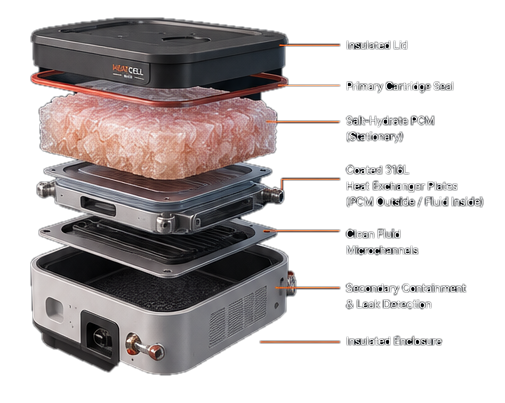
A compact phase-change thermal battery designed around one deliberate rule: keep the salt stationary and keep the working-fluid channels clean.
Salt hydrates offer attractive thermal density, but corrosion, phase separation, crystal growth and poor heat transfer can undermine a small consumer product. HeatCell Mini Gen-1 is being engineered around those realities instead of hiding them.
The internal microchannels carry only clean working fluid. The phase-change material remains stationary outside two sealed 316L exchanger plates. Heat crosses the wall; the materials never mix.

Twelve parallel channels per exchanger plate carry approved water/glycol—not PCM—so salt precipitation cannot block the hydraulic path.
A sealed PCM cartridge sits inside separate secondary containment with leak sensing and fault response designed into the system architecture.
Graphite-rich interfacial regions are being evaluated to shorten the conductive path through stationary PCM while controlling viscosity and segregation.
HeatCell Mini is not trying to replace a whole-home electrical battery. It is being developed as a modular thermal buffer for loads that already need heat.
Charge from an approved heat source, hold thermal energy in the PCM, and release it later through the closed water/glycol loop.
An isolated thermal loop can transfer stored heat into an approved preheat exchanger without exposing potable water to PCM chemistry.
Thermal storage can be placed between generation and delivery to explore load shifting, cycling reduction and thermal smoothing.
The same architecture can accept compatible waste-heat sources where the temperature window matches the selected PCM formulation.
Clean fluid enters the buried exchanger channels and transfers heat across the coated metal wall.
The stationary salt-hydrate PCM absorbs latent heat as it moves through its designed transition range.
The thermal gradient reverses and stored heat returns to the working-fluid circuit.
Temperature, flow and leak monitoring are intended to inhibit charging and isolate the module when faults are detected.
The launch site will distinguish clearly between design targets and validated specifications. Capacity, cycle life, corrosion resistance, standby loss and safety claims will move to the specification sheet only after representative hardware passes the relevant test gates.
Follow pilot testingWe will publish the conditions behind thermal-capacity, standby-loss and cycling figures rather than comparing heat storage with electrical storage without context.
The cartridge architecture is being developed around inspection, traceability, controlled replacement and eventual reconditioning or materials recovery.
HeatCell Mini can store compatible thermal energy from electric and non-electric sources, including heat pumps, natural-gas systems, solar thermal, recovered appliance heat, and other approved sources.
HeatCell Mini separates the reusable enclosure, controls, and thermal interfaces from the sealed PCM cartridge. The architecture is designed for service rather than disposal.
Cycle and calendar-life figures are engineering targets until validated. Warranty terms should be set only after qualification and field data support them.
Single-module entry point.
Join launch listSave $49 vs. two single units.
~0.30–0.50 kWh-th targetSave $197 vs. four single units.
~0.60–1.00 kWh-th targetPlanning wholesale price. Volume tiers available.
Installer program →Planning dealer price: $219 per standard unit, with future volume tiers, training, demonstration support, and qualified lead-generation tools.
Apply for installer updatesHomeowners, HVAC professionals, plumbers and energy researchers can register interest in controlled testing, installation studies and product feedback.